
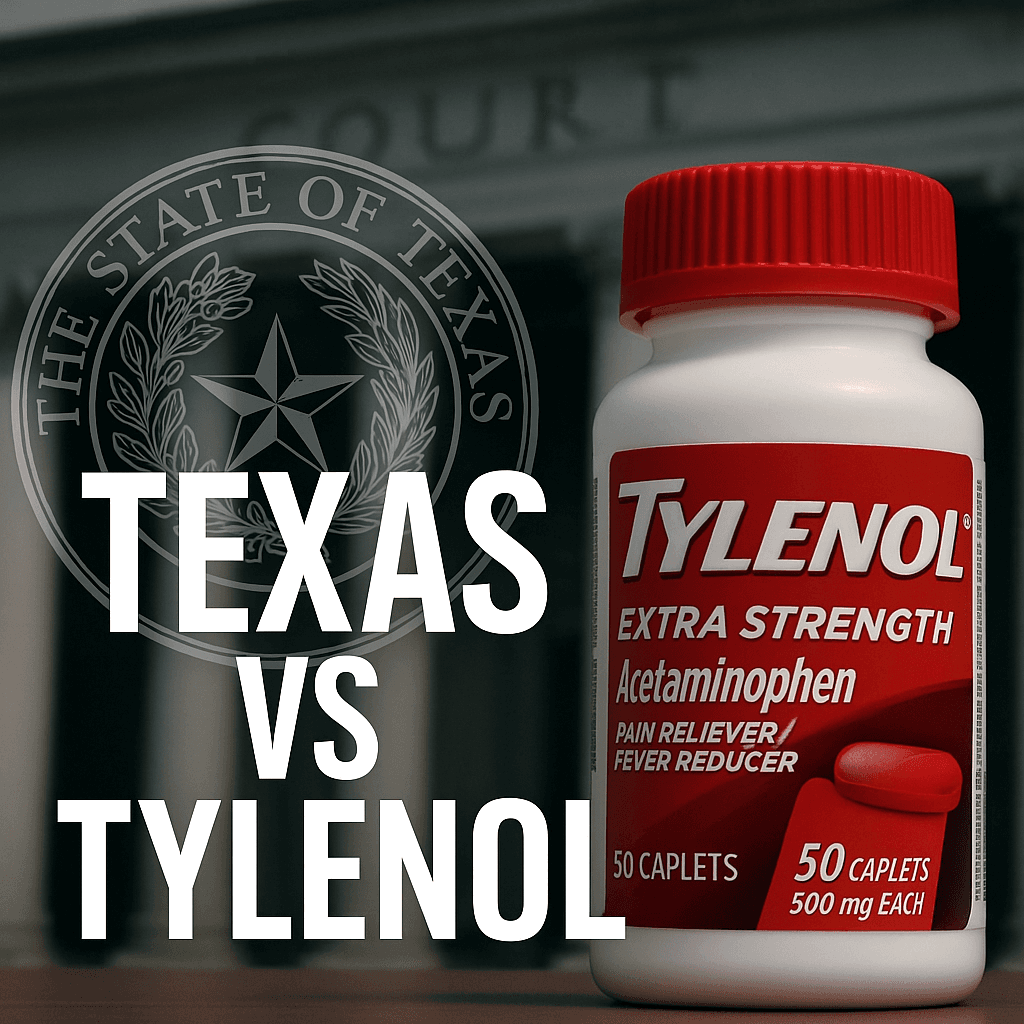
Texas Attorney General Sues Tylenol Makers Over Autism Claims
Published October 28, 2025
The Details
What’s Going On
Texas Attorney General Ken Paxton has filed a major lawsuit against Johnson & Johnson and Kenvue Inc., the company that now makes Tylenol.
The lawsuit claims the companies misled consumers by marketing Tylenol (acetaminophen) as safe for use during pregnancy while knowing it could be linked to autism and ADHD in children.
Paxton says the companies used “deceptive trade practices” and even shifted liability to Kenvue when Johnson & Johnson spun it off — to dodge future lawsuits.
What the Lawsuit Is Attacking
The suit focuses on two main issues:
1. Advertising and labeling — It accuses the companies of failing to warn pregnant women about possible developmental risks.
2. Corporate maneuvering — It claims Johnson & Johnson moved Tylenol’s consumer business to Kenvue to avoid being held accountable.
In plain terms, Texas is saying the companies knew about potential risks but didn’t tell the public, and then moved assets to make it harder for people to sue them later.
Have There Been Lawsuits Like This Before?
Yes — hundreds of private lawsuits have already been filed across the U.S. claiming Tylenol use during pregnancy caused autism or ADHD.
But most of those cases were dismissed because courts said the science isn’t strong enough to prove a direct link between acetaminophen and developmental disorders.
This Texas case is different because it’s being brought by a state attorney general, not individual families. That means it’s more about consumer protection and deceptive marketing than about medical malpractice.
Could Texas Actually Win?
It’s uncertain.
Courts have already ruled that current research doesn’t clearly prove causation, so Texas will have to show:
- The companies knew of credible risks and still marketed Tylenol as completely safe, and
- Their business transfer to Kenvue was done to escape liability under Texas law.
If the court finds proof of misleading marketing or corporate cover-ups, Texas could win penalties or force stronger warning labels.
But if the science stays inconclusive, the case could go the same way as earlier ones — dismissed for lack of proof.
Why It Matters
Even if the lawsuit doesn’t succeed, it raises big questions about:
- How much companies must disclose about possible risks,
- What counts as deceptive advertising, and
- How corporate spin-offs can protect (or hide) liability.
It’s a reminder that just because a drug is over-the-counter doesn’t mean there’s zero legal risk — for consumers or for the companies that make it.
Legal Hunt Newsletter
Stay smart about the law without the jargon.
Discover real stories and legal tidbits that actually make sense.
We’ll email a confirmation link. No spam—unsubscribe anytime with one click.
Join the Discussion
No comments yet. Be the first to share your thoughts!